For a More Creative Brain Follow These 5 Steps
The Toaster Project
In 2010, Thomas Thwaites decided he wanted to build a toaster from scratch. He walked into a shop, purchased the cheapest toaster he could find, and promptly went home and broke it down piece by piece.
Thwaites had assumed the toaster would be a relatively simple machine. By the time he was finished deconstructing it, however, there were more than 400 components laid out on his floor. The toaster contained over 100 different materials with three of the primary ones being plastic, nickel, and steel.
He decided to create the steel components first. After discovering that iron ore was required to make steel, Thwaites called up an iron mine in his region and asked if they would let him use some for the project.
Surprisingly, they agreed.
The Toaster Project
The victory was short-lived.
When it came time to create the plastic case for his toaster, Thwaites realized he would need crude oil to make the plastic. This time, he called up BP and asked if they would fly him out to an oil rig and lend him some oil for the project. They immediately refused. It seems oil companies aren’t nearly as generous as iron mines.
Thwaites had to settle for collecting plastic scraps and melting them into the shape of his toaster case. This is not as easy as it sounds. The homemade toaster ended up looking more like a melted cake than a kitchen appliance.
This pattern continued for the entire span of The Toaster Project. It was nearly impossible to move forward without the help of some previous process. To create the nickel components, for example, he had to resort to melting old coins. He would later say, “I realized that if you started absolutely from scratch you could easily spend your life making a toaster.”
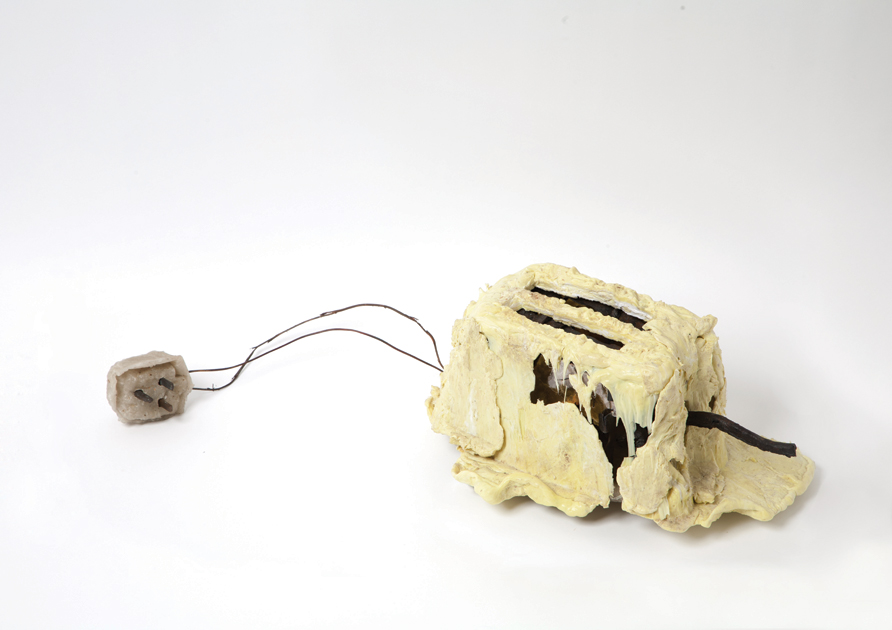
Thomas Thwaites set out to build a toaster from scratch. The Toaster Project, as it came to be known, ended up looking more like a melted cake. (Photo Credit: Daniel Alexander.)
Don’t Start From Scratch
Starting from scratch is usually a bad idea.
Too often, we assume innovative ideas and meaningful changes require a blank slate. When business projects fail, we say things like, “Let’s go back to the drawing board.” When we consider the habits we would like to change, we think, “I just need a fresh start.” However, creative progress is rarely the result of throwing out all previous ideas and innovations and completely re-imagining of the world.
Consider an example from nature:
Some experts believe the feathers of birds evolved from reptilian scales. Through the forces of evolution, scales gradually became small feathers, which were used for warmth and insulation at first. Eventually, these small fluffs developed into larger feathers capable of flight.
There wasn’t a magical moment when the animal kingdom said, “Let’s start from scratch and create an animal that can fly.” The development of flying birds was a gradual process of iterating and expanding upon ideas that already worked.
The process of human flight followed a similar path. We typically credit Orville and Wilbur Wright as the inventors of modern flight. However, we seldom discuss the aviation pioneers who preceded them like Otto Lilienthal, Samuel Langley, and Octave Chanute. The Wright brothers learned from and built upon the work of these people during their quest to create the world’s first flying machine.
The most creative innovations are often new combinations of old ideas. Innovative thinkers don’t create, they connect. Furthermore, the most effective way to make progress is usually by making 1 percent improvements to what already works rather than breaking down the whole system and starting over.
Iterate, Don’t Originate
The Toaster Project is an example of how we often fail to notice the complexity of our modern world. When you buy a toaster, you don’t think about everything that has to happen before it appears in the store. You aren’t aware of the iron being carved out of the mountain or the oil being drawn up from the earth.
We are mostly blind to the remarkable interconnectedness of things. This is important to understand because in a complex world it is hard to see which forces are working for you as well as which forces are working against you. Similar to buying a toaster, we tend to focus on the final product and fail to recognize the many processes leading up to it.
When you are dealing with a complex problem, it is usually better to build upon what already works. Any idea that is currently working has passed a lot of tests. Old ideas are a secret weapon because they have already managed to survive in a complex world.
Iterate, don’t originate.
In this article, I’d like to share 30 “one-sentence stories” about building better habits. (They are not all exactly one sentence, but they are very short.)
None of these stories are mine. They were sent to me by readers of Atomic Habits. My hope is that these examples will illustrate how real people are putting the book into practice. They will show you what people are actually doing to build good habits and break bad ones. And hopefully, they will spark some ideas for how you can do the same.
I have divided the stories into categories that roughly correspond to different sections or ideas in the book.
Identity-based habits
One of the central ideas in the book is the concept of building “identity-based habits”, which essentially recommends focusing on the type of person you wish to become rather than the outcome you wish to achieve.
One reader named Roland used the idea to improve his eating habits.
“I stopped eating unhealthy food via identity change,” he wrote. “I tried many times in the past, but it became easy — natural — only after I had made the conscious decision that I want to be someone who eats healthy. Instead of aiming for I want to stop eating bad food, I tried changing the mindset to I am someone that eats healthy and lives a healthy life. It changes how you approach things.”
Another reader named Robert employed this idea to help him quit smoking. He wrote, “I recently stopped smoking and the difference between I don’t smoke and I can’t smoke is a powerful trainer of my brain. The positive message of I don’t smoke is that I have not “given up” anything. I am not sacrificing a pleasure. I am investing in my future happiness and wellbeing.”
Like most strategies in the book, the concept of identity-based habits can be combined with other habit building tactics. For instance, one reader used an external reward of $10 to reinforce the desired identity. “I told myself, I am no longer a drinker. Then, after each day of non-drinking, I gave myself $10 to buy something nice rather than poison (like clothes and household items). Today, I no longer need the allowance and I’m six years sober.”
Chapter 2 of Atomic Habits covers these strategies in much greater detail.
Changing the Cues
Another way you can change a habit is by identifying and altering the cues that prompt your behavior. This is precisely what many readers have done.
One woman named Lisa cultivated a reading habit by increasing her exposure to books. “I’ve read more books by continually having 20-30 books on hold at the library,” she said. “It saves time on browsing for books. I always have new things to read with a three-week deadline.”
Heather used a similar strategy to reinforce the simple habit of drinking more water. “I use color and placement for visual reminding and motivation. I poured water in a bright aqua water bottle – my favorite color – and placed it on my nightstand so I couldn’t miss it when I woke up.”
Other readers have done the opposite. They reduced exposure to negative cues. One man named Max managed to eliminate his e-cigarette habit. “I quit e-cigarettes with a combination of determination and also quitting coffee at the same time, which was a trigger for me as I’d smoke and drink coffee together in the morning.”
Habit Stacking
Another popular tactic in the book is something I call “habit stacking.” It’s strategy I first learned from Stanford professor B.J. Fogg. He refers to it as “anchoring” because you anchor—or stack—your new habit onto a current habit.
One reader used habit stacking to create a simple rule for learning a new language.
“When I first moved to China and started to learn Mandarin, I committed to strike up a conversation with the taxi driver whenever I went into a cab (I took a lot of cab rides, 5+ daily). I did it for 2 years no matter the time of day or how tired I was. I now speak fluent Chinese.”
Similarly, a reader named David told me, “I meditate for 20 minutes after brushing my teeth in the morning. Linking new habits onto a keystone one seems to work.”
You’ll find all sorts of habit stacking examples in Chapter 5 of Atomic Habits.